Friday, October 30, 2020

Billy Tubbs: My Experience

In 1981-82, my sophomore year at OU which was my first, you couldn't pay anyone to attend an Oklahoma basketball game.

Not even me, no sir.
You see I grew up in Tulsa, weaned on Ken Trickey "We Run And Gun" offense at Oral Roberts University and had just spent a year in Kansas City in college where regular trips to Kemper Arena to see the Kansas City Kings in NBA action were the norm.
I knew great basketball when I saw it. And, I could smell bad basketball from a mile away...which was exactly how far my fraternity room was located from Lloyd Noble Center in Norman.
But in 1982, Tulsa's Wayman Tisdale surprised the college basketball world by spurning hometown coach Nolan Richardson's University of Tulsa Golden Hurricane, and chose to play his collegiate basketball in Norman at a football school, no less.
But in hindsight, it wasn't really that far-fetched for Wayman to mosey on down the Turner Turnpike to Norman.
You see OU had hired a little-known basketball coach from Lamar University in Texas by the name of Billy Tubbs in 1980, who had grown up in Tulsa of all places and graduated from Tulsa Central High School.
And the marriage with Tulsa-boy Tisdale was just what Oklahoma basketball and Tulsa-native Billy Tubbs needed to resurrect the basketball program in Norman.
And, boy. Did they ever.
By the fall of 1982, basketball games in Norman were must-see games because of Wayman's super-natural athletic prowess and Billy Tubbs' maestro-effect on the new run and gun offense.
Soon, the Sooner's basketball team was being mentioned with all the big boys, North Carolina and Michael Jordan, Patrick Ewing and Georgetown and Hakeem Olajuwon at Houston.
Why?
Because of Wayman Tisdale, obviously, but Billy Tubbs was the ultimate showman and basketball wizard who loved playing the collegiate basketball "villain" to Dean Smith's blue-blooded pedigree in Chapel Hill.
And the fans in Norman couldn't get enough of it...including me.
Soon, seats that you could've bought at the door the previous year, now required sending pledges three hours early to Lloyd Noble just to guarantee a good seat...in the student general admission section!
Four Big 8 Championships followed and appearances in the NCAA Tournament culminated in a NCAA Regional Final in Dallas and a heart-breaking loss to Keith Lee and Memphis State.
Yep, I was at that one, too!
Although, that would be Wayman's final game at OU, he would later be selected as the 2nd overall pick in the 1985 NBA Draft, Billy Tubbs would leverage that legacy and keep the Sooners relevant peaking at the 1988 NCAA Final in Kemper Arena in Kansas City Missouri.
The same Kemper Arena I used to go watch Kansas City Kings games...that one.
And, yes, I was there that night that Danny Manning and 'The Miracles defeated OU 83-79 to win the National Championship.
Coach Tubbs would remain at OU until 1994 and eventually found his way back home to Lamar University before retiring.

I was fortunate to meet Coach Tubbs at the 2016 NCAA Final Four in Houston after the Sooners loss to Villanova. I spotted him leaving the concourse and went up and introduced myself and the only words I could muster were: "Thank you!"
Coach Tubbs is 85. He is truly an ambassador for Oklahoma basketball and will always be remembered for restoring basketball to the same level as the football team in Norman.
Which is no easy feat.
Tubbs family announced today that their father has been placed in Hospice care near Lake Texhoma.
Please join me in sending love and prayers to the Tubbs family including Tommy and Taylor, who both attended OU, in this trying time.
We love you Coach Tubbs...and thanks for the memories!

Friday, October 23, 2020

Stan Richards: My Experience

Stan Richards: My Experience

This article was posted on my  LinkedIn page earlier this week.

I have added the link here for you to read.


 https://www.linkedin.com/pulse/stan-richards-my-experience-g-w-hail

Thursday, October 15, 2020

Remembering Gene Shell


I saw recently where Gene Shell passed away.

Last Thursday to be precise.

I was saddened by the news but knew he was in his 90's.

Guerin Emig, sports columnist with the Tulsa World, wrote a nice article on Shell a few years back that chronicled a group of his players who still had weekly dinners at the coaches house.

Remembering their days as one of his players. Remembering the good times. The good teams.

And that's where I'll begin my blog post.

Remembering the good times. Good teams. As a fan.

Gene Shell was born in Tulsa and attended Tulsa Webster High School.

My alma mater.

Shell was a three-sport star in football, basketball and baseball.

He was named Oklahoma All-State in baseball his senior year.

Afterwards, Shell ended up at Tulsa Webster as its baseball coach.

Shell's Warriors would win three state baseball championships.

His 1961 & 62' teams won in back-to-back fashion.

In five years Gene Shell's Tulsa Webster Warriors baseball teams were 87-8.

Bob Stoops would've been proud!

I don't know if you can classify Shell's Tulsa Webster teams into a category. 

After all, I was born in 1962. 

And its' not like you can find anything about those teams now other than word of mouth and memories.

But I heard the stories about the legends.

The Calmus brothers.

Myrle in 1959 would later play at Oklahoma State and sign with the Los Angeles Dodgers (I'm not sure Myrle pitched for Shell but his younger brother did...).

And Rich starred on those Gene Shell Webster baseball teams in 61' & 62'.

As pitchers.

Carl Morton?

Yep.

Pitcher.

Steve Rogers?

Later at the University of Tulsa?

Pitcher.

So I'm gonna go out on a limb and say Gene Shell's baseball teams emphasized pitching.

And why not.

Good pitching beats good hitting. Right?

After Tulsa Webster, Shell ended up at Edison and Claremore High Schools.

And guess what?

He won another state baseball championship.

Which caught the eye of the sharpies over at 11th and Harvard.

So Gene Shell became the head baseball coach at the University of Tulsa in 1966.

And this is where my story begins.

Growing up in the 1960's in Tulsa, I was focused on what all young boys were back then: sports.


But not necessarily the local kind, at first.

You see there was this fledgling NFL team in Dallas called the Cowboys.

And in Tulsa, you got all the Cowboys games every Sunday regardless of time zone, conference opponent or holiday.

So I was a Dallas Cowboys fan from the beginning. Before they were "America's Team" they were "Next Year's Champions."

Next.

I watched a lot of Major League Baseball.

The obvious choice was the St. Louis Cardinals since they were the parent club of the Tulsa Oilers, the Cardinals Triple-A farm club in Tulsa.

And the Cardinals won the 1967 World Series and were runner-ups the next year in 1968.

And a lot of those players came up through Tulsa on their way to the big leagues: Mike Shannon, Steve Carlton, Dal Maxvill and Ted Simmons.

So, I went to a lot of Tulsa Oiler games at old Oiler Park at 15th and Yale.

And hung out with guys like Satchel Paige who was an Oiler coach!

Satchel Paige used to sit in an old metal, folding chair in front of a card table and hold meet-and-greets with Oilers fans at the entrance to Oiler Park.

He teased me about my initials for a name the first time I introduced myself.

Until he glanced over and saw my dad...G.W. Hail, Sr. 

He quickly changed his teasing to my position of choice: catcher.

I told him I wanted to be like Johnny Bench because the catcher was in charge and the only player who could see the other eight players.

He went on about wearing all that equipment and that protective cup...in 100-degree Oklahoma heat!

Said he never had to wear no protective cup because nobody could ever hit his fastball hard enough to worry about it!

Besides, he said the catcher wasn't in charge. The pitcher was in charge!

After that first visit, every time he’d see me he’d say, “Hello, G.W. Hail, J-U-N-I-O-R! How’s that Johnny Bench dude doin’?“

Can you even imagine being blessed with Satchel Paige memories as an 11-year old kid! Oh, to have had an iPhone and social media in 1973!

Back to my dad. In addition to my name, he’s responsible for my Johnny Bench fascination.

He spent the summer of 1970 in Tampa, Florida, working and then after work at Al Lopez Field, spring training home to the Cincinnati Reds.

In addition to the black and white photos of Casey Stengel in a New York Mets cap and Stan Musial, with his wife and daughter, he sent home weekly black and white photographs of emerging Reds stars like Pete Rose, Binger, Oklahoma catcher Johnny Bench and rookie manager Sparky Anderson.

So, as I began my Little League career in the spring of 1970, the Big Red Machine, which moniker wouldn't be coined until later, was my fave team. 

And, because of this photo of Johnny Bench, I would soon be a catcher. A position I would play for the next 11 years!


NOTE: This photo was taken at Al Lopez Field in 1970 at spring training. I got the autograph 18 years later in Oklahoma City at an Oklahoma Olympic Festival fundraising dinner at the Myriad Convention Center. Bench was seated a couple of tables over and was signing autographs before dinner, so I went over and had him sign this and a 1972 baseball card. 

Locally, the University of Tulsa had tremendous success in football in the 1960's. Jerry Rhome and Howard Twilley set NCAA national records in 1964 with their aerial assault on the record books. 

And Twilley would return in 1965 and was named All-America.

A little-known freshman team coach that year was Gene Shell.

Across town Oral Roberts was building a university that God would be proud of. 

And, Oral believed the way to growing that university was to capture the hearts, minds and attention of the millions of American men who read the sports page daily.

So, Oral Roberts started a basketball program and eventually hired his man Ken Trickey as coach.

ORU ran off one of the best five year records ever. From 1969 to 1974, ORU basketball was 118-23 overall, including a NCAA Regional Final runner-up finish in 1974, and 52-0 record at home from 69' to 73'.

I attended a lot of ORU basketball games back then in the little on-campus "Igloo". 

I won't call it an arena because that wouldn't be fair to arenas. 

Let's just say it shared space with the school swimming complex and had a huge divider partition that separated the court from the pool. 

You could literally smell the chlorine during the basketball games!

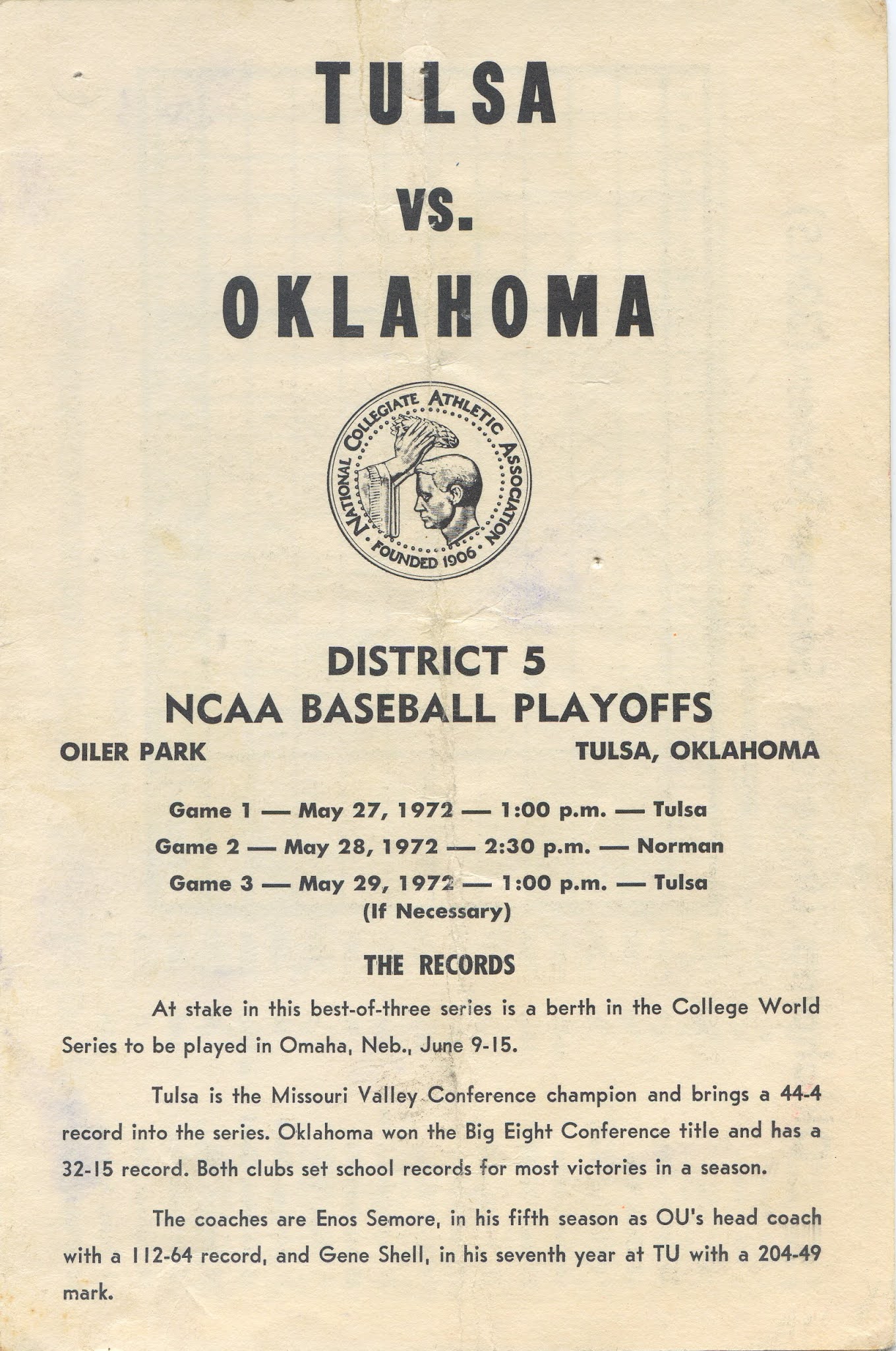
So this was my backdrop in 1969 when Gene Shell's University of Tulsa Golden Hurricane shocked the college baseball world and finished as runner-ups to perennial champion Arizona State in Omaha.

And I listened to every pitch on local Tulsa radio

It was fascinating.

Here was an alumni of my high school, coaching his team at the pinnacle of his sport and coming within one spot of winning a national championship.

So suffice to say I was a Gene Shell fan.
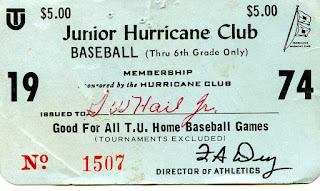
Soon, I would be attending all the games at Oiler Park and some at La Fortune Park across town. My mom would drop me off after school at around 3:30 p.m. and I'd spend the rest of the afternoon watching TU baseball!

No after school cartoons for me. No sir.

At the old venerable Oiler Park, I shagged right field fly balls for 10-cents a ball.

When I wasn't shagging fly balls I was sitting behind the third base dugout watching Shell coach and the Golden Hurricane play.

Occasionally, Coach Shell would notice me sitting there and reach into his bucket and toss me a baseball!

And although the usual Missouri Valley stiffs came through like Southern Illinois (they were actually very good), Creighton and  Bradley, coach Shell didn't shy away from playing the big boys, too.

Annual home games at Oiler Park included Arizona State, USC, Oklahoma, Arkansas and Oklahoma State.

These were some of the best baseball teams in the country.

In fact, Bobby Winkles’ Arizona State Sun Devils and Rod Dedeaux' Trojans from Southern California won 9 of 10 College World Series titles beginning in 1965.

Enos Semore down in Norman had some solid Sooner baseball teams and Oklahoma State was pretty fair in those days too.

So Gene Shell took on all-comers. 

And I got to see it all right there at Oiler Park.

Anthony Davis may be known for leading the Trojans big Thanksgiving Day comeback against Notre Dame, but he was in Tulsa in 1974, wearing a splint on his thumb, and I got his autograph on the back of my Junior Golden Hurricane Club Card!

During a period of four years beginning in 1971, future Major League players such as Fred Lynn of USC and Jackson Todd, Joe Simpson and Bob Shirley of Oklahoma all would make appearances in Tulsa playing the Golden Hurricane.

In the summer, I was the batboy for the Malone Metals.

They were Tulsa Webster's American Legion entry at La Fortune Park.

So I hung around all summer with all the Webster baseball players who also played in the summers for Malone Metals.

Guys like Ira Willis, Rick Willis, Ron Richardson, Gary Bushyhead and Steve Bowling.

Steve Bowling would graduate from Webster in 1970 and went to (where else?) the University of Tulsa and played for Gene Shell.

Bowling would set school records and lead the Golden Hurricane back to the College World Series where they finished 3rd.

Others on that 1971 team included slugger Jerry Tabb, pitcher Cliff Butcher and Steve Rogers.

In fact as late as 1977, Bowling and Tabb held every single individual career batting record at the University of Tulsa except one: home runs and that record was held by Ed Stephenson.

Bowling, Butcher, Tabb, Dean Graumann, Phil Honeycutt, Les Rogers, Steve Rogers and Mike Sember would all be named All-Americans. 

All would have Major League Baseball careers.

By high school, my attention was pulled toward my own career in football and baseball.

I was a three-year varsity letterman in football and baseball and would up on the 1980 Tulsa World All-City Baseball Team second team. 

Although I had always dreamed of playing for Gene Shell, he never called.

I did play on back-to-back Babe Ruth and Mickey Mantle Oklahoma State baseball champions as a 15 and 16-year old that drew the attention of Enos Semore and Gary Ward.

But not seriously.

I knew my Sooner career was over before my official recruiting visit to Norman ever started.

Tulsa scout Troy Miles took myself and former teammates Mike Robinson, Scott Logsdon and Kelly Bell to OU to see the Kansas game in 1979.

We were to meet Coach Semore, receive a tour of the facilities and watch the Sooners cream the Jayhawks.

I sensed trouble when Donnie Graham, a Sooner outfielder, greeted us at the old baseball office trailer located behind the end zone of Owen Field instead of Coach Semore.

Later during the tour of the Bud Wilkinson Center, I asked Graham where Coach Semore was and he replied, "Oh, he's duck hunting today!

Someone from OSU called during the summer of 1978 of my Mickey Mantle State Championship run. They asked to speak to me and my dad said "I wasn't ready."

He was probably right.

I'd meet Gary Ward later during my senior year of high school and he was pleasant and said he could always use a good "left-handed hitter in Stillwater."

He was just being nice.

He had Mickey Tettleton and soon Robbie Wine as catchers in Stillwater.

So, resigned to the fact my baseball career was not in Norman or Stillwater I started looking at the University of Tulsa.

And just about the time I graduated high school in May of 1980, the rocket scientists at the University of  Tulsa decided to end the baseball program in favor of some women's sports.

So suddenly after 15 seasons of excellence, Gene Shell's career was over at the University of Tulsa.

Gene Shell would compile a 444-165 overall record during his career at Tulsa. 

I played a half season with the Mid-Continent American Legion team at La Fortune Park and then quit.

It was my second season with them and it wasn't my high school team because we didn't have enough players interested so I was sent to the Central Braves team.

Of course, Central had their own catcher and I was forced into center field.

And, center field for an American Legion team in Tulsa wasn't too shabby, and allowed me to show scouts versatility at another position, but it wasn't where my heart was that summer.

But before I quit, Baker University had sent Rob Daugherty, a Cherokee Indian from Jay, Oklahoma and its Native Affairs guy, to Tulsa to scout me.

Based upon Rob's report, Coach Keith Hackett put together a pretty impressive financial aid package and I soon found myself in Baldwin City, Kansas playing NAIA Division II baseball for the Baker University Wildcats.


By spring break I was the starting catcher against Arkansas in Fayetteville playing against my former teammate Mike Robinson.

I hit one home run.

Lettered on the Heart of American Conference Runner-Ups and then called it a day and headed to Norman where I graduated in three years with a Journalism Degree in Advertising.

Pretty salty Intramural football, basketball and softball player too.

I regret I never got to play baseball for Gene Shell at the University of Tulsa.

It was a dream.

But I'll never forget the memories he left behind with me during those radio calls from Omaha and watching those teams at Oiler Park and shagging those baseballs down that right field foul line.

Coach Shell wrote a book called "Bottom of The Ninth" that outlined his coaching philosophy and tips for kids who wanted to be the best baseball player they could be.

Kids like me.

In his book, he featured the "Prayer of a Game Guy" which ends with this:

"When in the falling dust I get the final bell, I ask for no banners or complimentary stones.

I'd only like to know that in time gone by, You'll feel that I've been a Good Game Guy.

Amen."

Gene Shell.

A true Warrior and legendary Golden Hurricane. 


A Good Game Guy.


Sunday, July 26, 2020

History of Freshman Quarterbacks at Oklahoma


Red shirt freshman Spencer Rattler is poised to start at quarterback for the University of Oklahoma, if and when there is an actual college football season.

That puts him in rarefied air at tradition-rich Oklahoma where two of the last three Sooner quarterbacks have won the Heisman Trophy and were selected back-to-back #1 NFL draft choices.

Oh, and don’t forget Sam Bradford and Jason White who won Heisman’s in the first decade of the 21st century!

So with that review, let’s travel way back in the Sooner football time capsule to 1972, the first year freshmen became eligible to play NCAA football in 20 years, and take a look at how freshmen and red shirt freshmen quarterbacks have fared in Norman.

Kerry Jackson, 1972.

Barry Switzer had been Oklahoma’s Offensive Coordinator since 1966. 

And it was at Switzer’s suggestion three games into the 1970 season that convinced head coach Chuck Fairbanks to switch offenses to the Wishbone.

Fast-forward to 1972 after a record-breaking 1971 offensive performance that resulted in 472 yards rushing per game, and Switzer was busy recruiting looking for the next Jack Mildren.

He leaned on a relationship from his Arkansas days with Galveston Ball High School Coach Joe Wooley, who was born in El Dorado, Arkansas not far from Switzer’s hometown of Crossett, Arkansas.

Switzer told Berry Tramel of the Daily Oklahoman in 2013, 

“I knew Joe really well. Good relationship with him. I thought we could get Kerry.”

But there was only one problem.

Kerry Jackson was black.

And as Tramel pointed out, black quarterbacks were years away from being accepted by college fan bases.

Prentice Gautt was the first black football player at Oklahoma in 1957.

Texas integrated football in 1970.

Alabama in 1971.

A black quarterback at the University of Oklahoma in 1972 seemingly was unheard of.

But “Bootlegger’s Boy” Switzer got the approval from Fairbanks to recruit Jackson and he signed with the Sooners and immediately earned playing time.


Jackson backed up Senior Dave Robertson and was OU’s third leading rusher through four non-conference games with 286 yards on 44 carries.

An ankle injury suffered in a game 5 loss to Colorado, Oklahoma’s only loss on way to an 11-1 record and #2 national ranking, limited Jackson’s playing time the rest of the year.

On a very good Oklahoma football team.

The 1972 Sooners featured a high-powered rushing game featuring senior halfback Greg Pruitt from Houston. Both Pruitt and center Tom Brahaney would be named All-Americans.

Plus the Oklahoma defense featured all three Selmon brothers for the first time featuring nose guard Lucious and tackles Lee Roy and Dewey Selmon, all eventual All-Americans. Rod Shoate and Derland Moore were named  All-America in 1972, as well.

Oklahoma would face Penn State in the 1972 Sugar Bowl which would be the first night-time Sugar Bowl and only time the game was played twice in the same year following the 1971 game which was played on New Year's Day 1972.

Kerry Jackson saw action and is shown in this rare black and white video from the game (the only images of Jackson as a Sooner that I could find!) NOTE: Sorry, video doesn't play on mobile devices.


However, that was the end of Kerry Jackson’s future as Oklahoma quarterback.

Fairbanks resigned in January to coach the New England Patriots and Switzer was elevated to head coach.

In April, Jackson was deemed ineligible as it was revealed administrators at Galveston Ball High School had changed the transcripts of Jackson and teammate Mike Phillips so that they could qualify for OU.

Jackson had to sit out the 1973 season and watch a sophomore named Steve Davis run the Wishbone to near-perfection leading OU to a 10-0-1 record.

However, due to Jackson’s and Phillips’ ineligibility from  the year before, the Sooners were ineligible for television or bowl games for the next 2 years.

Davis would return in 1974 and lead Oklahoma to an undefeated season and fourth national championship.

He did it again in 1975 with an 11-1 record and fifth national championship.

Davis would end his career and Switzer’s first three years with a 32-1-1 record.

No one ever heard from Kerry Jackson again.

Even Switzer was amazed 41 years later as he related to Tramel,

“Kerry Jackson was going to be our quarterback,” Switzer said. “Steve Davis would never been the damn quarterback if Kerry had been eligible. Kerry was really a good talent. He was going to be a great player.”

To his credit, Jackson stayed in Norman. Even after he suffered a broken sternum in an off-season car crash not long after his ineligibility was announced. 

He eventually backed up Davis in 1974 and rushed for 12 yards on 17 carries.

In 1975, he was fourth string behind Dean Blevins, Joe McReynolds and Thomas Lott.

Kerry Jackson finished his Oklahoma career with 316 yards rushing on 67 carries and one touchdown and 231 yards on 15 for 49 passing and no touchdowns and 6 interceptions.

Troy Aikman, 1984


Troy Aikman may be best remembered as a 3-time Super Bowl-winning, NFL Hall of Fame quarterback with the Dallas Cowboys.


And deservedly so.


But before he became Mr. Cowboy, Aikman was a freshman quarterback at the University of Oklahoma.


Barry Switzer was coming off of three straight 4-loss seasons when he recruited Aikman from Henryetta, Oklahoma.

Aikman arrived in Norman in 1984 and was prepared to back up starter Danny Bradley.


However, Bradley was injured before the seventh game and Aikman found himself thrust into his first collegiate start for the #2 ranked Sooners against unranked Kansas in Lawrence.


Oklahoma entered the game 5-0-1, it's only blemish a 15-15 tie suffered two weeks before in Dallas.


No one expected Oklahoma to miss a beat with Aikman at quarterback.


However, after leading the Sooners to a first quarter field goal, Aikman was bullied and buried by Mike Gottfried's defense as Kansas upset Oklahoma 28-11.


Switzer said this after the game,


Aikman was a,


"whipped pup...but a great kid, gave us all he had, wrong place, wrong time for him."


Aikman would return for his sophomore season in Norman as the starter.


After leading the Sooners to the first three wins of the 1985 season Aikman suffered a broken ankle against Miami.


He was replaced by a true freshman from Carson, California who led the Sooners to eight-straight wins and a sixth national championship.


Aikman transfered to UCLA with Switzer’s help and the rest of the story as they say was history.


Jamelle Holieway, 1985


Jamelle Holieway was a 5' 9", 180 lb. quarterback from Banning High School in Wilmington, California when he arrived in Norman in 1985.


The Sooners were coming off a 9-2-1 season following three-straight 4-loss seasons and looking to reclaim their ranking atop the national standings.


Holieway found himself backing up sophomore Troy Aikman and up until that ill-fated broken ankle against Miami, it appeared Holieway was destined for a back up role.


However, the kid from Carson, California seemed born to run the Wishbone as the Sooners ran off 8-straight wins en route to the program's sixth national championship with a 25-10 win over Penn State in the Orange Bowl.


Holieway became the first true freshman quarterback to lead his team to a national title.


He seemed destined to a long, illustrious career at Oklahoma and more national championships. 


However, after losing to Miami again in 1986 for the Sooners only loss, he was injured late in the 1987 campaign and replaced by red shirt freshman Charles Thompson.


Thompson would lead Oklahoma to victory over Missouri and Nebraska and in the Orange Bowl against Miami again for the national championship but the Sooners lost 20-14, the third straight loss to Miami in three seasons.


The Jamelle Holieway era at Oklahoma stood at 28-1, three straight Big 8 Championships and Orange Bowl appearances and one national championship.


Holieway rehabilitated his injured leg, backed up Thompson for the entire 9-2, 1988 season and then took over for an injured Thompson playing his last game in the Gator Bowl at the end of that season in a 13-6 loss to Clemson.


Ironically, that loss would also be the final game for Barry Switzer, as well. 


Charles Thompson, 1987


Charles Thompson's career was inter-twined with  Jamelle Holieway as the red shirt freshman from Lawton took over late in the 1987 season replacing an injured Holieway.


Thompson led Oklahoma to victories over Missouri and Nebraska and then he started in the Orange Bowl against Miami for the national championship.


Oklahoma's offense proved no match for Miami's superior defense which bottled up Thompson and the Wishbone attack.


The Sooners late touchdown via "fumblerooski" only seemed to highlight Miami's superior defense.


The only way Oklahoma could score was via a trick play.


Thompson led the Sooners to a 9-2 record in 1988 substituting for the injured Holieway.


However, he too would be injured in the final game of the season and was replaced by Holieway in the bowl game versus Clemson, a 13-6 loss.


Barry Switzer was fired in June of 1989 amid controversy in the program tied to a federal drug sting involving the arrest of Charles Thompson (whose orange clad, shankled image made the cover of Sports Illustrated) and other player incidents involving an athletic dormitory rape and shooting incident involving two players over a bad haircut.


Thompson served 17 months in prison and never played another down for Oklahoma.


He ended up at Central State University, a historically black university located in Wilberforce, Ohio. He played running back on the 1992 NAIA Division I national championship team. Thompson rushed for 1,018 yards on 200 carries and five touchdowns and caught 29 passes for 439 yards and seven touchdowns. 


He left school after his junior year to enter the 1993 NFL draft but his past proved too much for NFL teams. 


Thompson was not drafted.


His son Kendall was signed by Oklahoma in 2011 and played sparingly as a back up, red shirt sophomore quarterback before transferring to Utah in 2014.


Thompson's son Casey was signed by Texas in 2018 and is currently a red shirt sophomore quarterback.


Charles Thompson still lives in Oklahoma and is a motivational speaker including past visits with the University of Oklahoma football team.

The Collins Brothers, 1989

Charles Thompson’s arrest created a quarterback scramble.

Steve Collins won the starting job over fellow freshman Tink Collins (not related) and became the first red shirt freshman to start the home opener in OU history on September 2 with a 73-3 win over New Mexico State.

However, Collins suffered a broken finger in the September 9 win against Baylor and Tink Collins replaced him. 

Sophomore Chris Melson got the start following the Baylor win and, in what was to become a signature loss in the Garry Gibbs era, the Sooners laid a night-time egg in the desert in a 6-3 loss to Arizona.

Gibbs went back to Tink Collins the rest of the way until November with Steve Collins return.

Tink Collins was 3-2 replacing Steve Collins and was benched after a 20-3 loss at Colorado.

Steve Collins would finish 2-1 losing to Nebraska 42-25.


This was Gary Gibbs first season replacing Barry Switzer and the first year of probation with no television or bowl games and a reduction in scholarships and recruiting visits.

The Big 8 torch was passed to Colorado and OU finished third in the Big 8 at 7-4.

After an incredible run from 1984 thru 1988, the Sooners would end the decade with a four loss season. 

Gibbs who was touted earlier in the decade as an up and coming defensive genius linked to the USC job, never recovered from the crippling NCAA sanctions Switzer left him.


The Sooners' three-year probation included a two-year bowl ban and a one-year ban on live television appearances. More importantly the number of scholarships which could be given annually was cut from 25 to 18 for two years. 

The number of official campus visits for recruits was reduced from 85 to 50 for two years. And the number of full-time coaches permitted to recruit off campus was cut from 10 to eight for a year.

And the NCAA instructed OU to take disciplinary action against three staffers, including two assistant coaches and a former recruiting coordinator.

OU was charged with 20 violations over an eight-year period. Most damning was a $1,000 offer from an assistant coach to Hart Lee Dykes, a highly recruited receiver who eventually signed with Oklahoma State (who also was put on a 4-year NCAA probation at the time).

However, the NCAA also found the Sooners were illegally scalping game tickets for players and one player was cited for accepting payment for work not performed and for receiving free use of a car 
owned by his employer.

And Switzer was cited for a violation for supplementing assistant coach Mack Brown's salary from his own pocket because there was not enough money in the budget to match what Brown previously made at a previous job.


Switzer called the NCAA violations "piss-ant" and revealed other violations the NCAA was unaware of in his biography "Bootlegger's Boy", that all fell under the category of helping student-athlete's through hardship.

How bad were the NCAA sanctions on the Oklahoma program?

Well, the five years before the sanctions and probation, Oklahoma went 51-8-1 with one national championship and the Sooners entered bowl seasons in contention for two other national championships.

Post-probation, OU's next three coaches combined to go 61-50-3. After a two year bowl ban ended, the Sooners only qualified for a bowl game in three of eight years.

The Oklahoma program would not fully recover until Bob Stoops was hired away from Florida in 1999.

The 1990's--The Lost Decade


After the best two-decade run in Oklahoma history, the nineties saw the worse decade since the 1960's.


Left-over probation from the end of the Barry Switzer-era led to only six winning records, zero conference championships, three bowl game appearances and four head coaches.


And a slew of no-name quarterbacks.


Too many to mention here.


But a few freshmen quarterbacks made starts. 


Red shirt freshman Eric Moore started all 11 games in 1995 in a 5-5-1 season for Howard Schnellenberger's only season in Norman.


Highly-recruited freshman Justin Fuente from Tulsa Union High School, started eight games in 1996 going 3-5 in a 3-8 season.


However, Fuente left for Murray State after his sophomore season in 1997.


Overall, 23 quarterbacks made starts for Oklahoma in the 1990's.


Cale Gundy will get the nod here.


The current Oklahoma inside receivers coach, Gundy arrived in Norman in 1990 and made five starts for head coach Gary Gibbs his freshman year leading the Sooners to an 8-3 record. 


He would go on to finish his career 31-13-2 as a starting quarterback and hold every single-season and career passing record in Oklahoma history.


Gundy would be named an All Big 8 first team quarterback his senior season in 1993.


Nothing else to see here.


Rhett Bomar, 2005


Rhett Bomar was Rivals #1 rated high school quarterback from Grand Prairie, Texas signed by Bob Stoops following his consecutive BCS national championship runner-up finish in 2004.


Stoops returned freshman sensation running back Adrian Peterson and Norman was a buzz to see him paired with freshman phenom Bomar at quarterback.


However, Oklahoma lost 10 NFL draft choices from the past two BCS National Championship runner ups, and 2005 would be a rebuilding year.


Stoops knew as much and was leery of starting a true freshman quarterback in the home opener against Gary Patterson’s TCU Horned Frogs.


Stoops had reason to worry.


After red shirt junior quarterback Paul Thompson appeared shaky, Stoops quickly replaced him with Bomar.


However, Patterson’s stingy defense had neutralized an injured Peterson and made Bomar look like a true freshman.


A fourth quarter fumble by Bomar late in the game, one of four by the freshman, set up a TCU touchdown for the winning score and TCU upset Oklahoma 17-10.


Shocker.


Bob Stoops football juggernaut had been beaten at home in the season opener after going undefeated in the regular season the past two seasons.


Despite the loss, Stoops stuck with Bomar the rest of the season.


And suffered growing pains.


After back-to-back BCS National championship appearances, Oklahoma was in a rebuild mode losing Heisman Trophy winning quarterback Jason White and a slew of talent on both sides of the ball.


So Stoops suffered through a season of hard knocks with a true freshman quarterback.


A blowout loss on the road to UCLA followed by a 45-12 humiliation to eventual national champion Texas, resulted in a Sooner record of 2-3.


Holy crap.


What the hell was happening in Norman?


Stoops settled things down with better defense, limited Bomar’s risk-taking by having him hand-off to Adrian Peterson and reeled off five wins to finish the season 7-4.


A controversial, last-minute 23-21 loss to Texas Tech in Lubbock, when a Red Raider running back was deemed to have scored when replays clearly showed his behind had hit at the three yard line, was the only thing keeping the Bomar-led Sooners to 6 straight wins to end the season.


Oklahoma’s first-ever Holiday Bowl appearance followed against Oregon in San Diego.


And Stoops and company rode Bomar, Adrian Peterson and a much improved Sooner defense to a 17-14 win to finish the season 8-4.


Suddenly things looked bright for a quick turnaround in 2006.


Both Bomar and Peterson returned along with an improved offensive line and the defense that showed improvement the year before.


After a disastrous 2-3 start, an 8-4 season in 2005 now seemed palatable to Sooner fans looking for a return to the BCS national championship game.


However, disaster struck off the field as Bomar and another player were caught accepting illegal payments for no-show work at a local automobile dealership in Norman.


Stoops reacted quickly and booted Bomar and the other player from the team.


Paul Thompson was moved from wide receiver back to quarterback for the season opener and Oklahoma would go on to win its fourth Big XII Championship in the Bob Stoops era.


Bomar ended up at Sam Houston State and a brief NFL career as a backup.


What started out so promising for the former #1 rated high school quarterback in 2005, ended abruptly after just one season.


Sam Bradford, 2007


Sam Bradford entered the University of Oklahoma in the fall of 2006 as a lightly-recruited freshman from Oklahoma City's Putnam City West High School.


A Sooner legacy, his father Kent had played for Barry Switzer in the 1970's, after a red shirt year, Bradford won a three-way battle for the starting quarterback job in 2007.


Bradford led the Sooners to wins over Texas and Missouri in the Big 12 Championship Game and if not for a last-second loss in Boulder to a tough Colorado team 27-24 and upset in Lubbock to Texas Tech, after he left the game with a concussion, the Sooners would have gone undefeated.


A surprise blowout loss in the Fiesta Bowl to West Virginia 49-28 dropped Oklahoma to an 11-3 record.


Returning in 2008 for his sophomore season, Bradford improved the Sooners to a 12-2 season and Heisman Trophy win ending in the BCS National Championship game versus Florida.


A loss to Texas 45-35 in the Cotton Bowl was the only blemish during the regular season but the Longhorns returned the favor on a last-second loss at Texas Tech that enabled the Sooners to win a three-way tie for the Big 12 Championship on a razor-thin tie-breaker rule.

A 24-14 loss to Tim Tebow and Florida in the BCS Championship Game only fueled the anticipation for the 2009 campaign as a host of starters were returning to Norman with Bradford.


However, Bradford was knocked out of the first-ever college football game in Jerry World in Arlington, Texas during the first half of the opening game against BYU.


Bradford suffered a clavicle injury, and although he rejected surgery and attempted an ill-fated comeback against Texas, was hurt again in the Cotton Bowl and was lost for the season.


The Sooners suffered along with freshman quarterback Landry Jones and finished 8-5 with a Sun Bowl victory over Stanford.


Although Bradford was eligible to return to Norman for his senior season in 2010, he elected to enter the NFL draft where he was promptly rewarded as the #1 overall selection along with fellow Sooners Gerald McCoy at #3 followed by Trent Williams at #4.


Landry Jones, 2009


Landry Jones was a highly-recruited quarterback from New Mexico and eventually signed with Oklahoma to back-up returning starter Sam Bradford in 2009.


However, Jones was thrust into the starter's role the first game against BYU and led the Sooners to a hard-earned 8-5 record.


You can hardly blame Jones.


True freshman who don't get any reps during the fall camp rarely see playing time except for injuries.


And that's exactly what happened to Jones his first year in Norman.


Despite being surrounded by a legitimate defense led by All-American Gerald McCoy, Jones struggled early and often to master the Oklahoma offense. 


Following a 14-13 loss to BYU, Jones seemed to hit his stride in back-to-back blowouts of Idaho State and Tulsa, 64-0 and 45-0.


However, those wins were followed by a tough 21-20 loss in Miami to the #17 ranked Hurricanes and a 16-13 loss to #3 ranked and eventual national champion Texas in the Cotton Bowl. 


A 10-3 loss to un-ranked Nebraska in Lincoln seemed to sum up Jones inefficiency at quarterback in 2009.


However, Jones would start his remaining three years in Norman and eventual assume every major passing record in the OU record book.


Jones led the Sooners to a 12-2 record and Co-Big 12 Championship in 2010 followed by a 10-3 record in 2011 and another 10-3 season and Big 12 Championship in 2012.


Ironically, Jones would be the last four-year starter for Oklahoma. 


He will be remembered by Sooner fans for incredible comebacks in Morgantown against West Virginia 50-49 and Oklahoma State in overtime in Norman 51-48 in 2012 and back-to-back blowouts against Texas in 2011 and 2012, 55-17 and 63-21.

Trevor Knight, 2013


Trevor Knight was a highly-recruited dual-threat quarterback from San Antonio Reagan High School in 2012.


He red shirted his freshman year and won the starting job over Blake Bell in 2013. 


Knight's running style would prove him injury prone and Bell would win the hearts of Sooner fans leading comeback wins over Notre Dame and Oklahoma State in 2013 following Knight injuries.


Following a 10-2 season in 2013, Knight led the Sooners to a huge upset win over Nick Saban and Alabama in the Sugar Bowl and seemingly propelled Oklahoma back into the national discussion for the 2014 season.


However, Knight would struggle mightily against Kansas State and TCU, in losses directly attributable to his pick-six interceptions, and eventually suffered an injury against Baylor in a third loss causing him to miss the last three regular season games.

He was replaced by red shirt freshman quarterback Cody Thomas who was 2-1 with wins against Kansas and Texas Tech followed by an overtime loss at home to Oklahoma State.

Knight returned for the Russell Athletic Bowl game and was 17-37 and 103 yards passing and 3 interceptions in a 40-6 loss to Clemson.

Red shirt sophomore Baker Mayfield won the quarterback competition for new Offensive Coordinator Lincoln Riley and took over in 2015 and Knight would eventually transfer to Texas A & M as a graduate transfer after the 2015 season.


Summary

So, the past 48 years of Oklahoma freshman quarterbacks certainly has been a roller coaster ride.


Since Kerry Jackson's inauspicious debut and subsequent ineligibility in 1973, the Sooners have seen a host of freshmen quarterbacks take their shot at leading Oklahoma to the promised land.


However, only true freshman Jamelle Holieway accomplished that feat coming off the bench to replace an injured Troy Aikman in 1985 and leading Oklahoma to eight straight wins culminating with a 25-10 win over Penn State in the Orange Bowl for the Sooners sixth national championship.


How rare was Holieway's true freshman heroics?


There wouldn't be a true freshman win a national championship for his school for another 33 years until true freshman Tua Tagovailoa led Alabama to a come-from-behind win against Georgia in the 2018 College Football Playoff.


So what to think about red shirt freshman Spencer Rattler taking the reigns in Norman in 2020?


No quarterback has entered his first start higher-rated or more accomplished than Rattler.


He has all the tools to be the best ever at Oklahoma.


However, as the past has shown, high school recruiting rankings can't predict eventual success in the college football world.


Just look no further than #1 rated Rhett Bomar's tenure in Norman to see what can happen to highly recruited freshman quarterbacks in Norman.


And as highly recruited as Rattler is, he isn't without his own off-field baggage.


Rattler was suddenly suspended at the end of his senior year in high school in Arizona for unnamed personal misconduct.


Lincoln Riley wasn't worried about whatever transgressions Rattler had done because he never wavered in his support and honored his scholarship offer.


But that behavior and that of guys like Rhett Bomar before him is enough to have Sooner fans old enough to remember a little nervous putting all of our eggs in one freshman basket heading into the upcoming season.


Let's hope Rattler has his head squarely on his shoulders and can handle the bright glare that goes with being a freshman quarterback at the University of Oklahoma.


And let's hope that if he can't or somehow is injured or comes down with COVID-19 and misses a game, that Tanner Mordecai, Chandler Morris and Tanner Shafer are just as capable back ups as Jamelle Holieway, Charles Thompson and Paul Thompson.


Because history has proven that at some point a back up quarterback, true freshman, red shirt freshman or even a wide receiver, will be called upon to save a game or a season.


Boomer.


An Open Letter to Seth Littrell

Brent Venables announced that wife Julie’s cancer is gone during his spring practice news conference this week. Hallelujah! The Oklahoma foo...